It started with a small Counter-Strike community
Shmery did not begin as a startup idea or as some plan to compete with the biggest communication apps on the internet. It started in 2018 as a practical tool for my own small Counter-Strike community.
Back then we needed something simple: voice channels that worked well, one place for announcements and a setup that actually felt like ours. That first version was primitive. No one should romanticize it. It was just enough to be useful.
But that is also why it mattered. It was built to solve a real problem, not to look impressive in a screenshot.
Why TeamSpeak 3 stopped being enough
TeamSpeak 3 was the obvious reference point because for voice it still did many things right. It was lightweight, focused and familiar. The problem was that it also came with things we increasingly disliked, especially the cost and friction around slot licensing.
For a small community, paying for slots felt like the wrong kind of limitation. We were not asking for some huge all-in-one platform. We just wanted a place to talk, organize ourselves and keep the community running without artificial constraints.
That is where Shmery started to become more than a toy idea. It became the answer to a very simple question: why are we still shaping our community around the limitations of someone else's product?
And no, Discord was not the answer for us
People will always ask: why not just use Discord?
The answer was simple then and it still matters now: performance. Discord had many features that looked nice on paper, but a lot of them were simply irrelevant for the way we used communication software.
At that time many people in the group were not playing on strong machines. If you play Counter-Strike, you already know how people think about hardware. Every FPS matters. A heavier communicator that burns resources on things you do not need is not neutral. It directly competes with the game.
If a communicator costs you frames and gives you features you never asked for, it stops feeling like a tool and starts feeling like a tradeoff.
That was the gap Shmery lived in from day one: TeamSpeak felt lighter but limited, while Discord had more social surface but felt too heavy for the real use case we had.
Early Shmery was extremely simple
The first versions had voice channels and one announcements channel. That was basically it. There was nothing sophisticated about it.
What mattered was that it was ours, that it matched our use case better than the alternatives and that it did not force unnecessary overhead on people with weaker PCs.
Today Shmery has almost nothing in common with that first version from a product perspective, but the original priorities are still visible underneath everything: performance, control and a voice-first structure.
Today it is a different product entirely
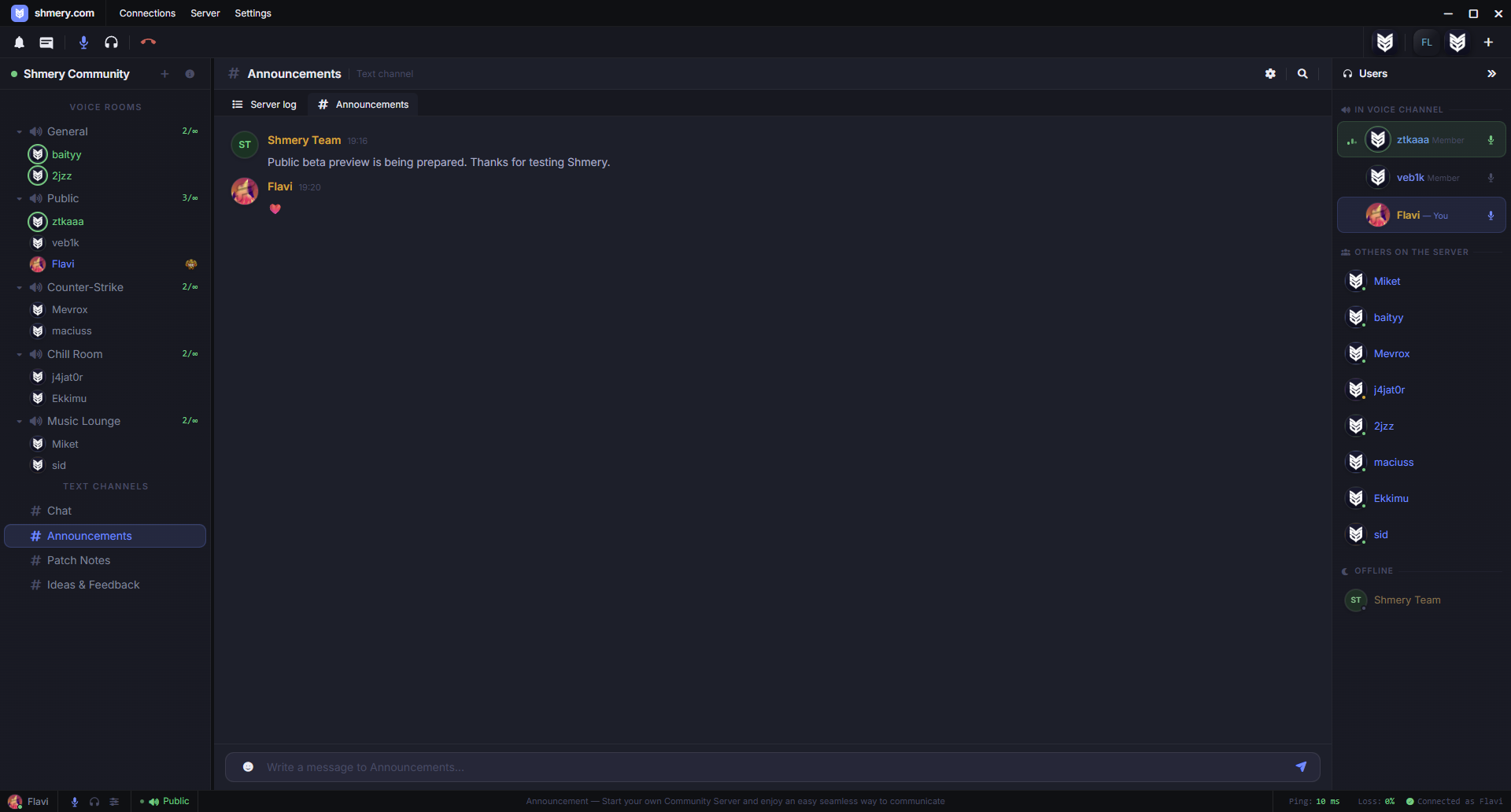
Modern Shmery is no longer just a small replacement tool for one community. It has grown into a proper desktop app with its own voice server, account system, social layer, badges, direct messages, aliases, permissions and text channels.
So while the original idea came from a very local problem, the current version is much broader and much more modern. It is closer to a real platform now, just one that still remembers why it existed in the first place.
That is important to me, because I do not want to build something that forgets its roots the moment it becomes technically interesting.
Turning the idea into a real product was harder than it looked
One of the strange things about software like this is that it can look finished long before it is actually real. A clean interface is the easy part. The hard part is making every piece behind it behave correctly when people actually start depending on it.
That meant replacing placeholder behavior with real communication, real state and real recovery when something goes wrong. Joining a voice channel, reconnecting after a brief outage, keeping the right people visible in the right place, handling roles and channel-level rules, making direct messages feel immediate, making unread counts behave properly, making bookmarks and aliases feel stable instead of fake: all of that ended up being more work than the visuals suggested.
A lot of the project was not glamorous at all. It was edge cases, synchronization bugs, reconnect bugs, permission bugs and the usual painful category of issues where everything works fine until a real person uses the app in the one way you forgot to test.
Voice quality was the hardest technical problem
Voice is where people become unforgiving immediately, and honestly they should. If text is slightly off, people can tolerate it. If voice sounds bad, cuts words, clicks at the start of speech or lets keyboard noise leak through, the whole app feels cheap no matter how good the UI looks.
So a lot of work went into things that many users will hopefully never notice directly: better speech detection, smoother transitions when someone starts talking, less harsh processing, stronger suppression of unwanted noise and cleaner reconnect behavior when the connection disappears for a moment and comes back. That kind of work takes time because the target is not just "it works." The target is that it should sound natural and stop getting in the way.
That was probably the biggest difference between building a voice app that functions and building one people actually want to sit in for hours.
Synchronization is always more work than it looks
Another lesson is that almost every feature becomes harder once more than one person is involved. Statuses, avatars, badges, roles, unread counts, quick conversations, channel membership and profile state all sound straightforward if you imagine them on one screen. They stop being straightforward the second you ask for every connected person to see the same truth at the same time.
A big part of development was making sure state changes propagate correctly, recover cleanly after reconnects and do not leave the app in some half-broken visual state where one person sees the old version and another sees the new one. That kind of reliability is not flashy, but it is the difference between a toy and a real daily-use app.
The real challenge is adding features without making the app heavy
This is probably the tension that defines Shmery the most now. It is easy to say "we want more features." It is much harder to add those features while still respecting the original reason the project existed: not everybody has a strong PC and not everybody wants a communicator that behaves like a second game running in the background.
So the technical challenge is not only shipping new things. It is shipping them in a way that stays efficient, remains optional where possible and does not punish people for having weaker hardware. That design pressure is still present in almost every decision.
Will Shmery get more features?
Of course it will. There is still a lot I want to add. That part is obvious.
The part I care about just as much is how those features arrive. I do not want Shmery to grow in the usual way where every new thing becomes another permanent tax on performance for everyone.
The goal is to keep optimizing and, where it makes sense, allow heavier features to be limited or turned off. I want people on strong PCs to get the full experience, but I also want someone with a potato PC to still run the app comfortably.
That was one of the reasons the project existed in the first place, and I do not intend to abandon that just because the app is more ambitious now.
I do not want to build a copy
I also do not want Shmery to become a clone of another communicator. Copies are always weaker than the original. A copy never becomes the original.
That does not mean pretending inspiration does not exist. Obviously it does. Good products learn from many places. But the goal here is not to imitate one specific app feature by feature. The goal is to build something of our own that borrows what is useful and leaves behind what does not fit.
I want Shmery to keep its own identity instead of becoming another product that feels like a reskinned version of something bigger.
We also want fewer restrictions, not more
Another part of the philosophy is that Shmery should not keep locking itself down the way many bigger communicators eventually do. I do not want it to become another environment where the user keeps running into arbitrary product limits that exist only because the platform owner decided they should.
That is part of why self-hosting still matters so much to the project. Control should stay close to the people actually using the software, not only to whoever happens to own the central platform.
- a self-hosted voice chat app
- a TeamSpeak alternative
- a Discord alternative for voice-focused communities
If somebody is searching for one of those things, I want Shmery to make sense immediately.
What is Shmery today?
Today, Shmery is already usable enough for daily use. People can connect, talk, organize themselves and actually live inside the app. But I still describe the project honestly: at this stage I call it alpha.
That is not fake humility. It just means I would rather be precise than pretend a polished UI makes a project finished. There is still a lot to improve, optimize and harden. And that is fine.
I would rather keep building carefully than rush into pretending the project is more complete than it really is.
Final thought
If I had to summarize the whole thing simply, I would say this: Shmery started as a practical answer to a small 2018 Counter-Strike community problem, and over time it turned into something far more ambitious.
It no longer has much in common with those first primitive builds, but it still carries the same priorities: voice first, modern without becoming bloated, optimized enough for weak hardware and built as something of its own instead of a copy.
More features will come. More polish will come. But the core rule stays the same: build something fast, useful and honest enough that even people with weak machines can still use it without feeling punished for it.
If you want the product context first, start with the comparison section or open the browser auth flow.